Reimagined Reentry Simulation
From improvised experience to a scalable, facilitator-ready system
The tension
The Restorative Justice Initiative had spent nearly a decade developing a reentry simulation used across organizations and states. The experience itself was powerful. People connected with it, learned from it, and carried it with them. But the way it had been built evolved organically over time. Materials were improvised, instructions were scattered, and much of the knowledge required to run it lived with the original team.
In practice, this meant the simulation worked best when those original designers were in the room. For new facilitators, it could feel overwhelming, difficult to follow, and hard to lead with confidence. At the same time, the initiative was trying to expand its reach and needed a version of the simulation that could travel, be picked up by others, and be implemented consistently.
My role
I was brought in to lead the redesign, with a focus on clarity, usability, and scalability under a tight timeline.
-
The first step was making sense of what already existed. There was a large volume of material, but it lacked a structure that supported clear decision-making. I introduced a layered approach that separated core system mechanics from structural organization and physical components. This allowed us to prioritize decisions in the right order and avoid getting stuck in details before the system itself was clear.
-
In parallel, I structured how the team worked. We implemented a decision-tracking process so key choices were documented and not lost, and established a rhythm that allowed the design team to move quickly while staying aligned with the broader group.
-
From there, the work became one of translation. I transformed dense, text-heavy instructions into clear, step-by-step processes that could be followed without prior expertise. Materials were redesigned to be durable and reusable, reducing preparation time and ongoing costs. The flow of the simulation was also restructured so both participants and facilitators could move through it more intuitively.
-
We also reimagined how the simulation exists in space. Instead of relying on bulky and inflexible formats, we conceptualized a portable system that could be easily carried, set up, and implemented across different contexts.
-
Within one month, the team moved from a fragmented collection of materials to a fully redesigned prototype. It was produced, tested, and implemented in a 50 and a 75-person simulation at Penn State and at New York City.
-
What changed was not the purpose of the simulation, but its capacity to exist beyond the original team. It retained its depth while becoming something others could pick up and run. It no longer depended on a few individuals to work well. It became a system.
The shift
That shift was immediately visible. Long-time collaborators recognized the difference, and new stakeholders, including funders, saw the transition from an improvised experience to a coherent, intentional, and scalable tool.
Floor Plan

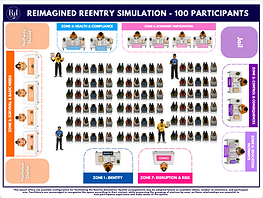
Before: Layout depended on memory and improvisation; stations were placed inconsistently across locations; facilitators had limited guidance on flow, spacing, or participant movement; confusion emerged during setup and transitions.
AFTER: Clear, standardized floor plan integrated into facilitator materials; stations organized intentionally to support flow and interaction; facilitators can set up confidently in new spaces; participant movement is intuitive and aligned with the simulation logic.
Facilitator's Guide

Before: Fragmented instructions spread across documents and personal knowledge; heavy reliance on experienced facilitators; difficult for new facilitators to understand sequence, roles, and timing.
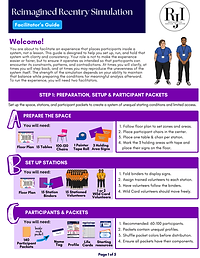
AFTER: Consolidated, step-by-step facilitation guide; clear structure from setup to execution to wrap-up; designed for independent use without prior experience; supports consistency across different facilitators and locations.
Volunteer Instructions


Before: Minimal or informal guidance; volunteers relied on verbal explanations; inconsistent understanding of roles; frequent interruptions to clarify tasks during the simulation.
AFTER: Role-specific, clearly written instructions; quick-reference format for ease of use during live sessions; volunteers understand responsibilities without constant support; smoother execution and reduced dependency on lead facilitators.
Participants Profiles


Before: Paper-based profiles with inconsistent formatting; difficult to track progress; information scattered and not always intuitive; limited durability for repeated use.
AFTER: Structured, reusable profile system with clear organization; participants can easily track their situation and decisions; consistent format across all profiles; designed for durability and repeated implementation.
Participants Life Cards

Before: Loose tracking of participant status; reliance on verbal updates or facilitator memory; limited visibility of participant progress within the system.

After: Integrated life card system for real-time tracking; visual and interactive components make status visible and tangible; supports participant engagement and system clarity; reduces facilitator burden.