The Conscientization Wheel
Systematizing Activist Knowledge into a Pedagogical Framework for Community Organizations in Puerto Rico
The tension
A grassroots organization in Puerto Rico approached me with a concern that is common but rarely addressed well. Long-standing activists within their networks held decades of experience, insight, and hard-earned learning about organizing. However, this knowledge remained dispersed, informal, and difficult to փոխանց to newer generations in a structured way. They wanted a way to capture, interpret, and reuse that knowledge so it could guide future practice.
MY ROLE
I designed and led a process that combined participatory research, critical analysis, and pedagogical design.
-
The work began with data collection through a series of individual and group interviews with experienced organizers. These conversations surfaced not only strategies and practices, but also the implicit ways in which activists learn, adapt, and sustain their work over time. To deepen the analysis, I integrated a body of literature on global social movements and learning, drawing connections between local experiences and broader patterns across contexts.
-
From there, I developed a structured analytical framework. Instead of presenting findings as isolated themes, I organized the data into a matrix that distinguished between more and less generative learning practices within organizing contexts. This allowed us to move from description to evaluation, identifying what supports emancipatory forms of learning and what limits them.
-
Building on this analysis, I designed a model that enables practitioners to map their own pedagogical practices. Through a structured questionnaire, participants can locate themselves along a continuum, from more limited approaches to more emancipatory ones, making their own assumptions and practices visible.
-
To support ongoing use, I translated the framework into a set of practical tools, including a workbook and a series of guides that help individuals and organizations strengthen specific areas of their pedagogical practice. These tools were designed not as static materials, but as instruments for reflection, dialogue, and continuous development.
-
My role extended across the full arc of the work. I conducted the research, synthesized and analyzed the data, developed the conceptual model, designed the materials, and facilitated presentations to introduce both the findings and the tools for application.
The Shift
The result was a shift from dispersed, experience-based knowledge to a shared, structured system that organizations can use to reflect on, assess, and evolve their own practices over time. What had previously lived in memory and informal exchange became something that could be engaged, adapted, and carried forward intentionally.
The dialectic toy
.jpg)
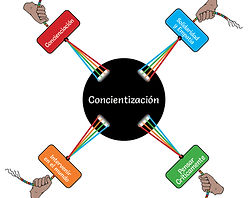
As part of this process, we designed a small tactile tool – a wooden pull-string “dialectic toy” meant to embody tension, movement, and contradiction in a playful way. It serves as a physical metaphor for conscientization: stretching between forces, feeling pressure, and finding new space through movement. While it remains a prototype, it represents our commitment to learning that is not only intellectual, but emotional, relational, and embodied.
The wheel
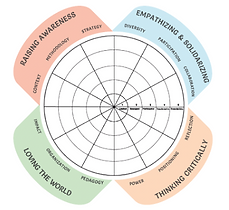
The Wheel is a visual and reflective structure that allows groups to map how they are currently practicing across the four tensions that shape emancipatory pedagogy. Instead of positioning learning as a path from “less” to “more,” the Wheel invites people to locate where energy is strongest, where it is stretching, and where it has not yet been activated, not as failure, but as a reading of present conditions.
The Workbooks
While the Wheel gives us a way to see practice. The workbooks give us a way to stay with that seeing. They do not arrive as manuals or answers, but as companions for shared study.
Each one holds a different part of the work: understanding the pedagogy, locating our practice inside it, and talking together about what we see. The intention is simple: to help groups build language, notice patterns, and choose how to grow based on what already exists, not on imposed ideals.


WORKBOOK 1: INTRODUCING OUR PEDAGOGY
This workbook opens the door into our shared pedagogy. It walks through the research, movement lessons, and collective reflection that shaped this approach, and it explains how to use the materials that follow. As you read, you will find space to pause, take notes, and connect the ideas to your own practice. This is not a manual to follow, but a companion for understanding where this work comes from and how you can engage it with
intention, curiosity, and care.
WORKBOOK 2: MAPPING AND REFLECTING ON OUR
PEDAGOGY
This workbook supports us in looking closely at how we teach and learn together. It brings two kinds of tools: simple questions that help us map our current practices, and open-ended prompts that invite deeper conversation about what those practices mean. Use it to pause, notice what is really happening in our educational spaces, and put language to what we often sense but do not always name. It is both a mirror and a dialogue partner: a way to see our patterns from the inside, compare experiences with others, and explore where we might want to grow next as a community.
WORKBOOK 3: BUILDING OUR PEDAGOGY
This workbook supports us in moving from reflection to intentional practice. Using what we learned from mapping and discussing our pedagogy, it offers a space to design learning experiences rooted in community and shared power. Rather than prescribing methods, it invites groups to experiment, adapt, and build on what already exists. Here we sketch ideas, plan next steps, and test new approaches in real contexts. Think of it as a workshop for collective imagination
and practice: a place to shape educational work that strengthens awareness, deepens relationships, and advances the world we are committed to building together.
pUBLICATION

This paper introduces the Conscientization Wheel, a participatory model grounded in popular education, aimed at facilitating conscientization through four interconnected dimensions: raising awareness, empathizing and building solidarity, thinking critically, and nurturing a love for the world, applicable in various learning contexts.
pUBLIC sPEAKING
Presentation to introduce the Wheel in the Adult Education Research Conference, Alabama (2025), the Critical Adult Learning and Education Conference , Malta (2025), and the Penn State PostDoctoral Symposium, Pennsylvania (2025), where it won Best Choice-Audience Award.